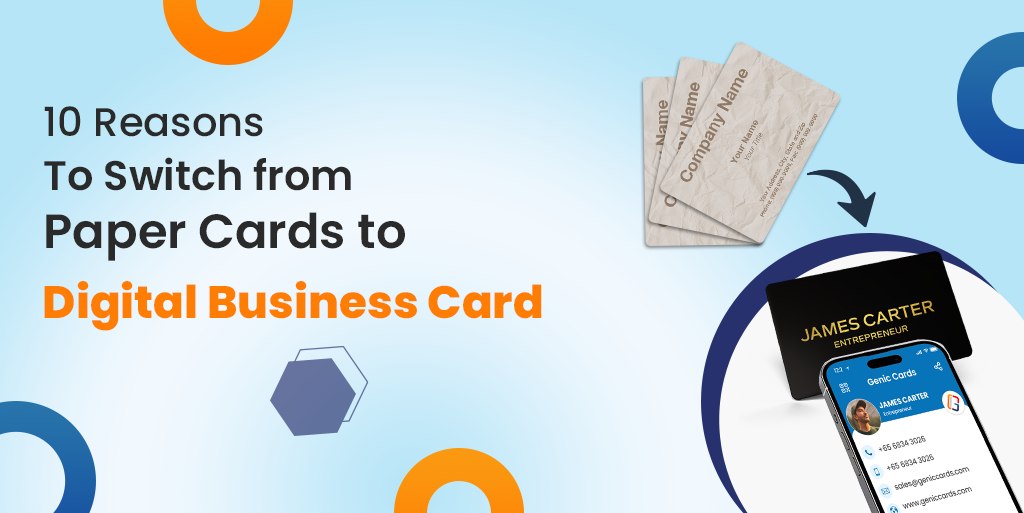



In today’s business world, sharing contact information has become faster and more digital. Earlier, paper business cards were widely used to share information during conferences and meetings.
But, printing paper cards needs huge paper usage, high costs, and more whenever details need to change. Digital business cards allow professionals to share their information easily using a mobile device. It easily stores all business details in a single card without space restrictions and can be updated anytime with minimal effort.
In this guide, you will learn about key reasons to switch from paper cards to digital business cards and their comparison in terms of adoption in countries like Singapore.
1. Avoid the Paper-Making Process
Digital business cards remove the need to buy paper. Before the evolution of digital business cards, paper cards were made from a large amount of paper, which harmed the environment by cutting trees to produce paper and following a comprehensive manufacturing process.
However, with digital cards, there is no need to cut down trees, as you can create as many cards with minimal effort.
2. Share Your Information Quickly
You can share all the required information from a single app. An e-name card stores all the information about you that is necessary for business. Unlike paper cards, which hold very limited space, the digital card has no restrictions.
You can add contact numbers, social media links, website URLs, and other information you want to share.
Electronic business cards allow you to include your company name, what it does, office address, designation and phone number. All these details are available online for clients through a digital card.
3. Generate Instant Leads
Digital business cards strongly support marketers in lead generation. They allow a quick and smart way of contact sharing, which helps your potential clients to access your details instantly.
The cards work smoothly with tools such as appointment setters, which simplify meeting scheduling with prospects.
In this technology-driven world, every business is adopting technological innovations to speed up its daily operations, which can lead to the generation of leads quickly and help your business to grow rapidly.
4. Easily Update Your Card Information
The advantages of digital name cards are that owners can easily update their details at any time. If you need to change or add your address or anything else, then it can be done quickly. Any updates you have made are shown quickly in real time.
This is different from paper cards, which need to be reprinted in large batches whenever details change. So, using a digital business card can help you to change your information without any problem.
5. Get Greater Results from Digital Business Cards
A digital card gives you better results quickly. For example, at a conference, someone can scan the QR code from your card to get your contact details easily.
Most digital business cards have several options to save or share details with the clients, which makes it easy for clients to get your details on their phones. These cards also offer useful analytics.
If you are using a digital card, then you can see data such as where viewers are from, which platform they are coming from, and how many people have viewed your card.
These are the key benefits of using digital name cards. You can design your business card online with simple steps.
6. Save Money
When adopting a digital card, you can save money. Printing business cards is expensive due to paper purchase, design, and printing.
For companies, the annual printing cost per card increases as the number of employees rises every year. With a digital card, there is no need to print, which saves cost at a high margin.
So, a digital card is a cost-effective alternative to paper cards. They remove the need to print and the storage problem.
7. Easy to Carry and Share
Digital business cards are easy to carry as they are stored on your mobile device. Unlike paper cards, there is no need to carry them in wallets or card holders.
You can share your digital card anytime using a QR code, link, email, or messaging apps. This makes networking more convenient during meetings, events, or online interactions.
Since the card is always available on your phone, you never have to worry about cards running out or being forgotten, which makes contact sharing quick and hassle-free.
8. Eco-Friendly and Sustainable
Digital business cards help reduce environmental impact by removing the need for paper and printing. Traditional paper cards require trees and ink during production, which contributes to environmental damage.
By switching to e-name cards, businesses can support sustainability and reduce waste. Digital cards can be reused and updated multiple times without creating additional waste.
Using digital business cards shows environmental responsibility and helps organisations contribute towards greener and more sustainable business practices.
9. Never Lose Contacts
Paper business cards can easily be lost, damaged or misplaced. Digital business cards reduce this risk by allowing contact details to be saved instantly on devices or online platforms. Once shared, clients can access your details whenever needed.
Digital cards make it easier to store, retrieve, and manage contacts without manual effort. This ensures that important connections are not lost and helps businesses maintain long-term professional relationships more efficiently.
10. Better Brand Representation
Digital business cards allow businesses to present their brand more effectively. You can customise your card with brand colours and logos to create a professional appearance. Unlike paper cards, digital cards also allow clickable links, images and other interactive elements.
This helps businesses to make a strong impression and clearly show their brand identity. A well-designed digital card looks innovative and professional, helping businesses stand out and leave a lasting impact on potential clients and partners.
Also Read: What Is a Digital Business Card and Why It’s the Future of Networking
Paper vs Digital Business Cards in Singapore
The comparison below highlights the key difference between paper and digital business cards, which helps businesses to choose the right option for them:
| Point of Comparison | Paper Business Cards | Digital Business Cards |
|---|---|---|
| Paper Usage | Paper business cards require large amounts of paper, which is produced by cutting trees and following a long manufacturing process. | Digital business cards do not require paper, as they are created and shared online with minimal effort. |
| Information Sharing | Paper cards can store only limited information due to space restrictions. | Digital cards allow you to store and share complete business information, such as contact details, websites, and social media links. |
| Updating Details | Any change in information requires printing a new set of cards, which takes time and increases cost. | Digital cards can be updated instantly, and changes are shown in real time without reprinting. |
| Cost | Printing paper cards involves expenses for paper, design, printing, and storage. These costs increase over time. | Digital business cards remove printing and storage costs, making them a cost-effective option. |
| Accessibility | Paper cards can be lost, damaged, or forgotten, and are only shared in person. | Digital cards are always available online and can be shared anytime and anywhere. |
| Business Results | Paper cards do not offer tracking or performance insights. | Digital cards provide analytics such as views and engagement, helping businesses achieve better results. |
| Environmental Impact | Paper cards contribute to environmental damage due to paper waste. | Digital cards support sustainability by reducing waste and protecting the environment. |
FAQs
Digital business cards make contact sharing simple and fast. They store all business details in one place and can be updated anytime. Unlike paper cards, they do not require printing. They are easy to share online, eco-friendly, and help businesses connect with clients more efficiently.
Digital business cards allow easy sharing, quick updates, and cost savings. They support branding and improve networking results. However, they require a mobile device and internet access. Some people may still prefer paper cards for traditional or formal business situations.
Digital business cards may face minor risks, such as data privacy issues or technical problems like a poor internet connection. These risks are low and can be managed by using a secure platform. Overall, digital cards remain a safe and reliable option for business networking.
You can convert a physical business card to digital by using a digital business card platform. Add your details manually or scan the card, customise the design, and create a QR code. Once done, the card can be shared online easily.
Switching to digital business cards helps businesses save money, reduce paper usage, and share information quickly. They allow easy updates, better engagement, and improved networking. In a digital-driven business environment, digital cards offer a modern and efficient way to connect.